
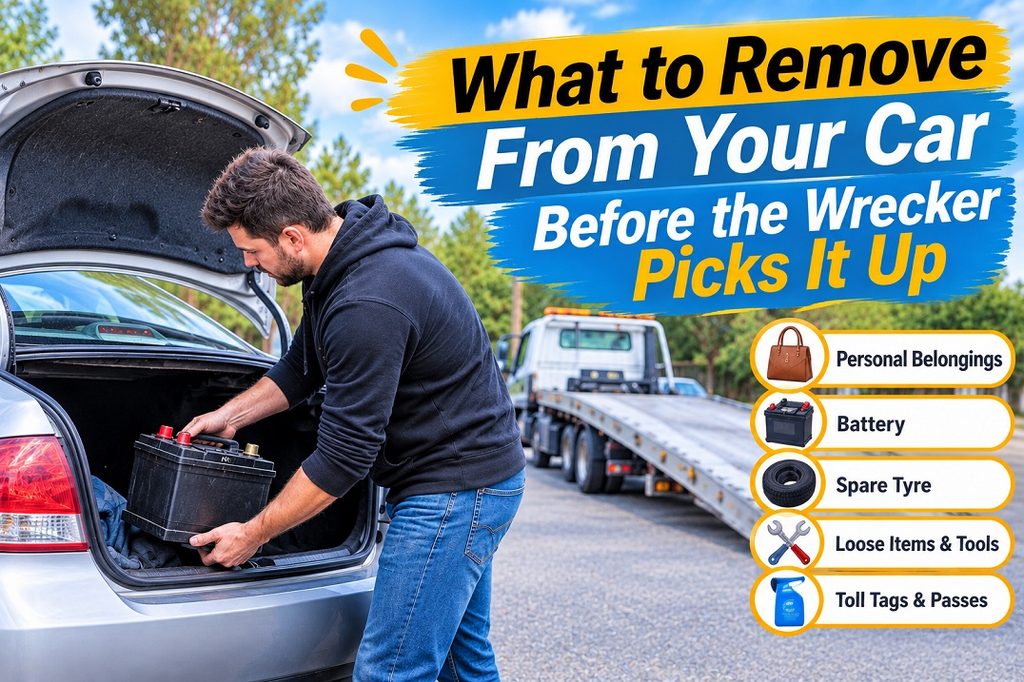
Before a wrecker collects your car in Perth, remove your personal belongings (check the glovebox, boot, door pockets and under the seats), delete your personal data from the infotainment system, unlink any connected-car apps, and take out accessories you want to keep, such as child seats, dash cams and garage remotes. Leave the engine, gearbox, wheels, battery, catalytic converter and body panels in place unless you’ve agreed otherwise with the wrecker, because they make up the car’s value.
Key takeaways
- Once a car is collected, it can be processed quickly. Anything left inside is usually unrecoverable.
- Modern cars store your address, contacts and account logins, so wipe digital data as well as clearing the cabin.
- Removing major parts after receiving a quote can change your offer. Always tell the wrecker first.
- Don’t dismantle airbags, fuel systems or batteries yourself. It’s unsafe.
Why prepare your car before pickup?
Selling a car to a wrecker is quick, which is exactly why preparation matters. Once the vehicle is towed away, you can’t assume you’ll get anything back. Wreckers dismantle cars for parts, recycle metals and fluids, and move vehicles through their yard on a schedule.
Preparing your car protects three things:
- Your belongings. Wallets, medication, documents and keepsakes get lost far more often than people expect.
- Your privacy. Infotainment systems can store home addresses, phone contacts, call logs and linked accounts.
- Your payout. The wrecker prices your car based on what it expects to receive. Taking parts off afterwards, or leaving a mess of hazardous items, can create delays or changes to the offer.
The complete checklist: what to remove from your car
1. Personal belongings (check every compartment)
Don’t just glance at the seats. Check:
- Glovebox and centre console
- Door pockets and seat-back pockets
- Under and between the seats
- Sun visors and overhead sunglasses holder
- Boot, spare-wheel well and any underfloor storage
- Ashtray and cup holders
- Roof lining pockets and hidden compartments
Typical forgotten items include sunglasses, coins, chargers, medication, USB sticks, parking permits, toll or fuel receipts with your address, and old mail.
2. Documents you want to keep
Keep your logbook, service history, insurance paperwork and any old registration papers you don’t need to hand over. Your wrecker will tell you what they require. For the full list of what to give and what to keep, see our guide to the documents needed to sell your car to a wrecker in WA.
3. Keys, spare keys and remotes
Ask the wrecker which keys they want, and make sure you’ve located every key and fob. Also look for things that open other locks:
- Garage door remotes (often clipped to the sun visor)
- Gate remotes and building access fobs
- House keys on the same ring as the car key
4. Personal data stored in the car
This is the step most sellers skip. Modern infotainment and navigation systems can hold more personal information than you’d expect.
Delete or reset:
- Saved addresses, especially “Home” and “Work”
- Navigation and trip history
- Phone contacts and call history
- Bluetooth pairings and saved Wi-Fi hotspots
- Voice assistant data and saved profiles
Most cars have a “factory reset” or “delete personal data” option in the settings menu. If you’re unsure, check the owner’s manual or the manufacturer’s website.
5. Connected-car apps and online accounts
If your car links to a manufacturer app or a connected-services subscription, unlink the vehicle from your account and cancel any paid subscription. Also sign out of streaming, music and navigation accounts inside the car. This stops the next system holding your login and avoids paying for a service on a car you no longer own.
6. Dash cams and storage cards
Remove the dash cam, its memory card and any hardwired power cable you want to keep. SD cards can hold footage showing your routes, home and driving habits.
7. Child seats and baby equipment
Remove child restraints, boosters and baby capsules. Check the expiry date printed on the seat, since manufacturers set a lifespan. If the seat was in a crash, don’t reuse it, and follow the manufacturer’s replacement guidance.
8. Accessories you want to keep
You can usually take items you added yourself, such as:
- Phone mounts and sat navs
- Seat covers and floor mats
- Sunshades and window tint film (only if removable)
- Roof racks, bike racks and tow bars (tell the wrecker first)
- Aftermarket stereo, amplifier or subwoofer (tell the wrecker first)
9. Tools, jack and spare tyre
These come with the car. Ask the wrecker whether they’re counted in the quote before removing them.
10. Hazardous and loose items
Remove gas bottles, aerosols, paint, solvents and loose tools. These are a safety risk during towing and loading.
Remove, leave or ask first? Quick reference
| Item | What to do |
|---|---|
| Wallet, phone, medication, keepsakes | Remove |
| Garage and gate remotes | Remove |
| Saved addresses and Bluetooth pairings | Delete |
| Connected-car app link | Unlink |
| Child seats, dash cam, phone mount | Remove |
| Aftermarket stereo, roof rack, tow bar | Ask first |
| Jack, spare tyre, toolkit | Ask first |
| Engine, gearbox, wheels, battery | Leave |
| Catalytic converter, panels, seats | Leave |
| Fuel and fluids | Leave |
What should you leave in the car?
Leave anything that forms part of the vehicle:
- Engine and gearbox: the most valuable components in most wrecked cars.
- Wheels and tyres: often reusable, and they affect the car’s weight and value.
- Battery and alternator: common resale parts.
- Catalytic converter: contains recoverable metals.
- Body panels, doors, bumpers, lights and glass: frequently in demand as used parts.
- Seats and interior trim: reusable and recyclable.
- Fuel and fluids: the wrecker drains and disposes of these safely.
A wrecker quotes against the details you supply, so the car should arrive as described.
Read also – what information a wrecker needs to quote your car explains how that works.
Should you remove parts to sell separately?
You can, but weigh it carefully.
Risks:
- Removing a high-value part will almost always lower the wrecker’s offer for the rest of the car.
- It can be dangerous. Airbags, fuel lines and batteries shouldn’t be handled without training.
- If you remove parts after the quote, the wrecker may revise the price on arrival or refuse the pickup.
If you still want to:
- Tell the wrecker before accepting the quote.
- Ask for an adjusted price.
- Remove only simple bolt-on items, like a roof rack or aftermarket stereo.
- Don’t touch safety systems.
Extra checks for specific vehicles
Utes, 4WDs and trucks
Work vehicles often carry more equipment than you’d think. Check for:
- Toolboxes, canopies and drawer systems
- UHF radios, antennas and in-cab fridges
- Fuel, oil and chemical containers
- Bull bars, winches and driving lights you want to keep
Flood-damaged or accident-damaged cars
Water and impact damage can make interiors unsafe. Wear gloves, avoid touching exposed wiring, and be careful with broken glass. Items in a flooded car may be contaminated. know more about cash for flood-damaged cars in Perth.
Cars that don’t start
You don’t need to get the car running. Clear the cabin and data as normal. If the infotainment won’t power on, unlink your accounts through the manufacturer’s app or website instead.
Pickup-day preparation checklist
The night before:
- Clear all compartments and the boot
- Reset the infotainment system
- Unlink connected apps
- Remove accessories you’re keeping
- Locate all keys and remotes
Just before pickup:
- Take photos of all sides of the car, the odometer and the interior for your own records
- Confirm the agreed parts are still on the car
- Ask the wrecker how they handle number plates and the registration label, and follow their instructions
- Keep a copy of any receipt or confirmation
What happens after the car is gone?
Selling the vehicle doesn’t automatically end your responsibilities. You’ll need to let the Department of Transport know the vehicle has been disposed of, and cancel registration and insurance. Check the Department of Transport website for current WA requirements.
Ready to sell your car in Perth?
Clear out your belongings, wipe your data, and tell the wrecker about anything you’re keeping. That’s all it takes to hand over your car with confidence. Get started at Auto Wreckers Perth to request a quote.